Python is a powerful programming language. It’s quite easy to pick up and has a strong community worldwide. That’s why it has a huge number of user-created and maintained libraries for all kinds of things.
Today, we will exclusively discuss Python libraries in image processing, each topic Python developer should be familiar with. Image processing has many uses in the real world, for example OCR, designing, and forensics all use it in some capacity.
Whether your image processing tasks involve improving image quality, object detection, or automating visual tasks, the Python ecosystem provides the libraries to do it. So, let’s check it out.
Importance of Image Processing
Image processing is one of the technologies that is used every day, but we are not aware of it. He has an important role in various fields such as;
- Medical imaging
- Machine learning
- augmented reality
- Optical character recognition
- Designing
- Retailer
Etc. For example, traffic cameras can automatically detect violations using image processing. MRI and X-ray machine results are enhanced with image processing to make them easier to understand. Professional photographers use it to enhance their shots and recover details lost due to overexposure.
There are many such examples. Here are a few more to show you how widely Python image processing is used in many fields.
- Self-driving cars use real-time image processing to detect pedestrians, traffic lights, signs, roadblocks and more.
- In retail, inventory management and self-checkout systems use image processing to ensure there are no fraudulent scans (for example, shifting empty boxes).
- Security and surveillance systems use real-time image processing on camera feeds to identify movements, faces, and even crowd movements.
All these systems use many Python image processing libraries to perform their functions.
The reason we don’t realize it is because the image processing parts are packaged neatly in the form of easy-to-use applications and software, where the process is hidden from us.
Python Library it is usually used for development of such applications as it simplifies the process due to its powerful libraries and well-documented framework.
Let’s take a look at some of the most commonly used image processing libraries in Python.
Main Python Libraries for Image Processing
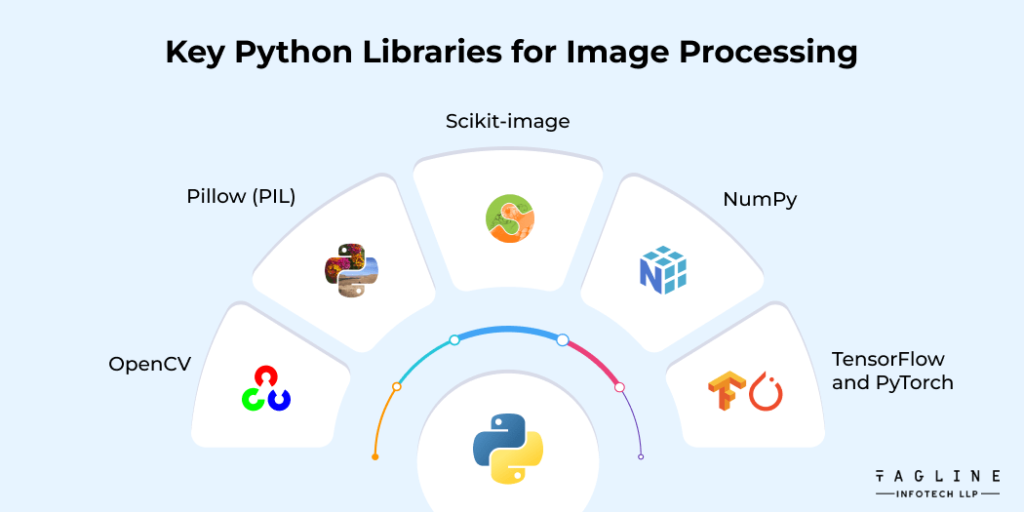
It is a popular and powerful image processing library available in Python.
OpenCV
OpenCV is one of the most widely used libraries. It provides various functions for image analysis, face detection, and video capture. It is quite popular because it works fast and has less programming overhead than other libraries.
Pillow (PIL)
Pillow is an easy-to-use library for basic image manipulation such as resizing, cropping, and format conversion. It’s ideal for lightweight applications and automation scripts.
Scikit Image
Scikit-image is a library built on top of NumPy and SciPy. It is designed for advanced image analysis and supports operations such as segmentation, morphology, filtering, and feature extraction.
NumberPy
Numpy is a number handling library. Although not an image processing library, NumPy is essential for handling image data as arrays. It provides the computational backbone for most image processing tasks.
TensorFlow and PyTorch
It is a deep learning library and is invaluable for image recognition, object detection, and neural style transfer. Currently, they support many AI-based visual applications.
This library was used in the development of various applications, many of which we use today. Novice programmers can easily learn to use this library for their own applications and experiment with it.
Integrating Image Processing with Other Tools
Python libraries can be combined with various web-based tools to provide specific functions or enhance existing functions. For example, in a image to text converterOCR libraries like pytesseract are used to extract text from images.
However, Tesseract itself is not very accurate unless you use very high quality images. That’s why many programmers usually use OpenCV together with pytesseract to extract readable text from images. In this scenario, OpenCV is used to improve image quality before OCR is performed. This is called image preprocessing.
An example workflow looks like this:
import cv2
import pytesseract

# simple preprocessing + OCR

img = cv2.imread('scan.jpg', cv2.IMREAD_GRAYSCALE)

_, th = cv2.threshold(img, 150, 255, cv2.THRESH_BINARY)

text = pytesseract.image_to_string(th)

print(text)
In this code, the image is being “binarized”, which is a process in which the color of the image is changed in such a way that the text contrasts well with the background. This makes it easier for pytesseract to recognize characters and perform its OCR function with much higher accuracy.
To add more functionality, you can read the documentation on OpenCV (or a library of your choice) and learn what functions it provides. Then you can add it to your pre-processing pipeline.
The Future of Python Libraries in Image Processing
The good thing about Python is that it is very popular, updated regularly, and has a wide community of hobbyists, professionals, and beginners. Everyone liked it enough to create libraries, update old libraries, create unique branches of existing libraries, and more.
So, in the future, Python will remain a major player in image processing, and will evolve over time to provide new functionality, improve existing functionality, and even create out-of-the-box solutions to various image processing problems.
Here are some ways that image processing in Python can improve in the future.
- AI improvements. Since Python is already widely used for machine learning, we can expect to see image processing libraries that leverage those capabilities to do things like improve image quality, recover lost detail, and remove artifacts.
- 3D Image Processing. Although current image processing technologies can be used with 2D images, in the future, we can expect Python image processing libraries to be able to handle 3D images and scenes as well.
- IoT Integration. Current libraries are too heavy to run on small computers such as IoT devices. In the future, we can expect these libraries to shrink in size and computing requirements so that they can also work on IoT devices.
These are just a few ways you can improve image processing with Python.
Conclusion
Python’s extensive library makes it a great programming language to perform image processing tasks.
Whether you want to make simple edits or perform complex computer vision tasks, you can rely on these tools/libraries to do it. If you run into any problems, you can check out the extensive documentation or ask questions to the large Python community.
If you are exploring a project in image processing, partner with those with experience python development company can help you seamlessly integrate these libraries into scalable applications.
This flexibility and support system of Python ensure its continued dominance in image-based applications across various industries.
FAQs
Pillow (PIL) is the best choice for beginners as it allows easy tasks like resizing, cropping and converting images without complex settings.
Yes. Libraries such as TensorFlow, PyTorch, and OpenCV enable deep learning and object detection, making Python suitable for AI-based image recognition, allowing it to perform advanced image processing tasks.
Pillow is a library for image manipulation. It lets you perform simple tasks like cropping, changing colors, and resizing.
OpenCV is much more advanced. Instead of manipulation, it focuses on analysis. It provides features like facial recognition, OCR, and pattern recognition.
Very. As you saw in the “Integrating Image Processing With Other Tools” section, it is possible to combine two or more different libraries, for example OpenCV and pytesseract.
News
Berita
News Flash
Blog
Technology
Sports
Sport
Football
Tips
Finance
Berita Terkini
Berita Terbaru
Berita Kekinian
News
Berita Terkini
Olahraga
Pasang Internet Myrepublic
Jasa Import China
Jasa Import Door to Door
Originally posted 2025-11-04 07:38:31.