Python has become one of the most popular languages in the development of modern web, and for good reasons. Simplicity, readability, and large framework ecosystem makes it a favorite among developers, from startups to companies at the company level. Whether you are building a small MVP or platform that can be discharged full, which is skilled Python development company Can take advantage of the Python web framework to accelerate your development and simplify complex tasks.
In this blog, we will dive deep into the framework of the top python website in 2025 and help you decide which is the most suitable for your project.
Why Choose the Right Web Python Framework is Important
When building a web application, the framework you choose can create or damage your project. In the world of web python development, choosing the right framework is not just about coding preferences – this directly affects the success, performance, and scalability of your application.
This is why choosing the right Python framework is truly important:
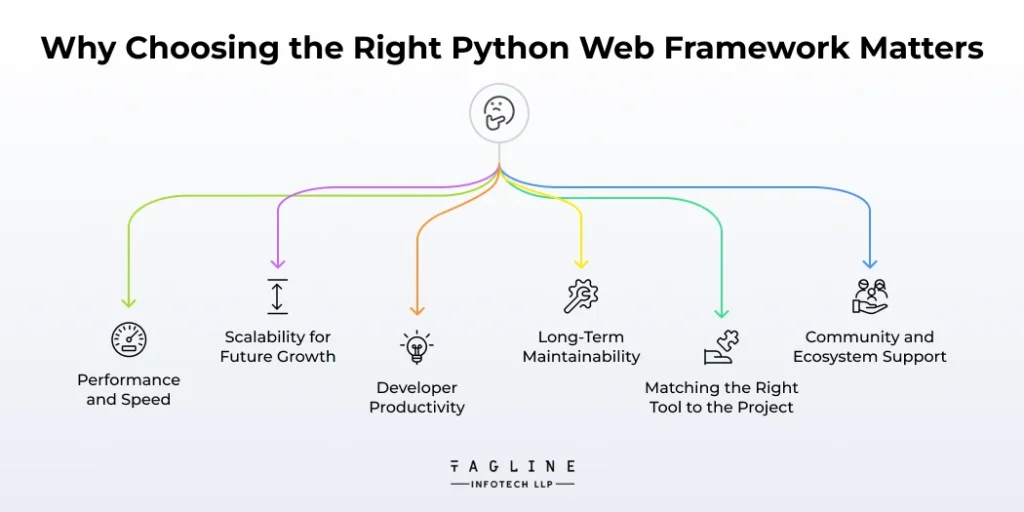
1. Performance and speed
The framework acts as the foundation of your web application. Some Python frameworks are optimized for high performance and ideal for real-time applications or high traffic platforms. For example, Fastapi is known for its asynchronous speed and ability, making it perfect for fire and heavy data applications. On the other hand, full framework like Django offers more innate features but may have a higher overhead in certain use cases.
2. Scalability for future growth
If you expect your application to grow from time to time, in terms of users, data, or features, scalability is the key. Frameworks such as pyramids or Django can handle complex architecture and large -scale applications easily. Micro work such as flask or bottles is more suitable for lightweight projects, but can require more manual work when increasing.
3. Developer productivity
The framework you choose affects how fast your development team can build and repeat. Full-Stack framework offers default components such as admin panels, ORM (Object-Relational Mapping), and authentication systems, which accelerate development. Django, for example, promotes rapid development with the philosophy of “battery-including battery”. Conversely, a minimalist framework provides more flexibility but often requires developers to build these tools from the beginning or integrate external packages.
4. Long -term maintenance
A good framework helps ensure that your project can still be managed from time to time. Clean architecture, solid documentation, and strong developer communities all contribute to easier maintenance. Choosing a mature and well -supported framework reduces the risk of technical debt and ensuring that you can keep your application updated with minimal complexity.
5. Match the right tool with the project
Each project has a unique need-is it a platform that is driven by content, calm fire, or time-message service. Choosing the wrong framework can cause inefficiency, unnecessary complexity, or even full rebuilding at the end of the road. For example:
- Simple portfolio sites may be excessive with Django, but perfect for bottles.
- The company’s CMS platform will benefit more than Django’s strong structure than flask.
6. Community and Ecosystem Support
Framework with strong community support tends to develop faster, receive frequent updates, and offer a variety of plugins or extensions. This support network makes development more smoothly and help solve problems quickly. Django and Flask, for example, have large and active communities that contribute to their sustainable success.
In short, the choice of the Python web frame of your choice has a long -lasting impact. This affects how fast you build, how well your application is performing, how easy the scale, and how smooth it can be maintained. Make the right decision from the beginning set your project for long -term success.
The main benefit of using the Python web development framework
The Python Web Development Framework has become an important tool for developers who aim to build an efficient, measured, and safe web application. Whether you launch a simple website or develop a complex company class platform, Python Frameworks offers various advantages that streamline the development process and increase overall productivity.
The following is closer to the main benefits of using the Python Web Development Framework:
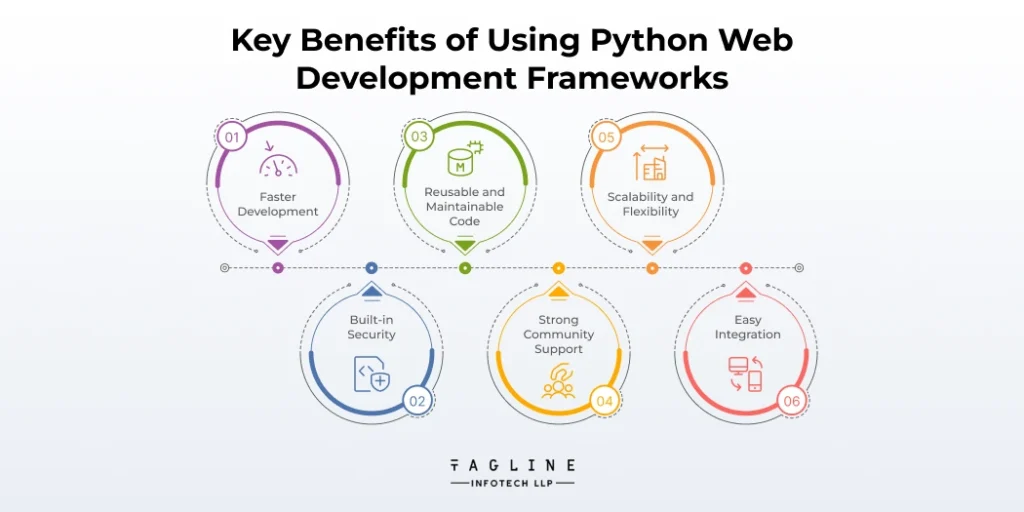
1. Faster development
Frameworks such as Django and Flask come with tools and modules that have been built, reducing the need to write codes from the beginning and speed up project delivery.
2. Default security
They include safety features to protect against general threats such as SQL, CSRF, and XSS injection, helping developers build safe applications quickly.
3. Code that can be reused and can be maintained
The Python framework promotes modular codes that are clean and easy to use and maintain-ideal for long and large-term projects.
The popular framework has an active community, offering a lot of documentation, tutorials, and third party tools to support developers.
5. Scalability and flexibility
Are you building a small application or large platform, the python frameworks scale easily and can adapt to any project size.
6. Easy integration
They integrate well with databases, front-end tools, cloud services, and Devops pipes, making it suitable for modern development needs.
The most popular Python web application framework in 2025
Let’s explore the Python Top framework used in 2025:
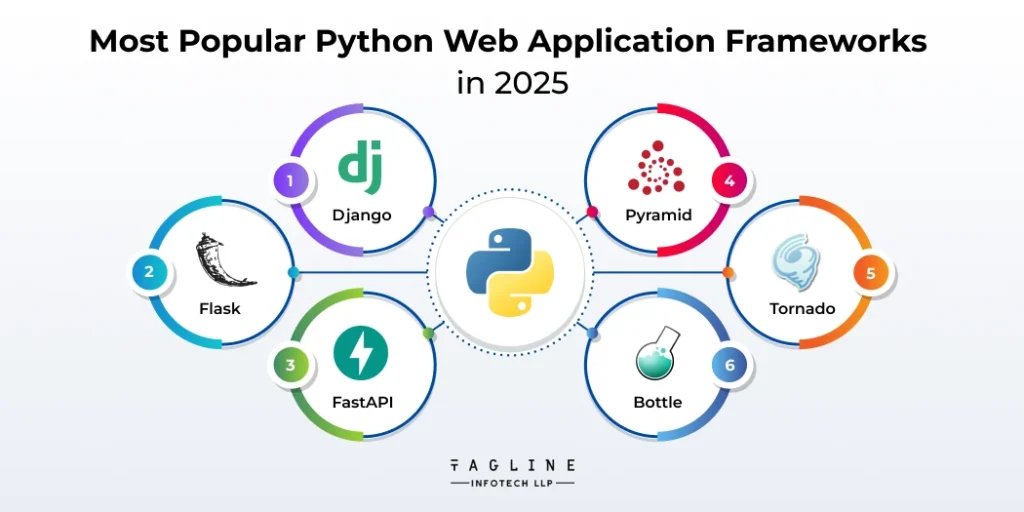
1. DJANGO-Full Working Framework for Applications that Can Be Discourse
Django is a power plant. This follows the “battery” philosophy, which means coming with almost everything you need outside the box:
- Innate ORM for handling databases
- Admin interface for fast content management
- Strong security steps
Using cases: CMS platform, ecommerce website, company application
Popular Site: Instagram, Pinterest, Disqus
2. Flask – Light and Flexible for Microser Services
Flask is a micro frame that gives you full control. This is ideal for smaller projects or micro service architecture.
- Minimum settingsPerfect for experiments
- Extension support For ORM, form validation, etc.
- Adjusted architecture
Using cases: Restful fire, microservices, fast prototypes
Popular Site: Netflix (part), Reddit API
3. Fastapi – Modern Python Web Kut Framework for API
Fastapi is a new favorite among fire developers in 2025.
- Asynchronous programming support
- Automatic interactive documentation with pride and redoc
- High performancecomparable to node.js and leave
Using cases: API Real-Time, Dissemination of ML Models, Modern Web Applications
Popular Site: Uber, Microsoft’s internal fire
4. Pyramid – The balance between simplicity and strength
The pyramid sits between Django and Flask in terms of complexity.
- Flexible For small and large applications
- Security oriented
- Dispatch & Traversal URL Routing option
Using cases: Medium -sized business application, dashboard
Popular Site: Mozilla, surveymonkey
5. Tornado-for real-time web applications
Tornado is an asynchronous framework that is built for performance.
- Handle thousands of connections simultaneously
- Perfect for websockets and long polls
Using cases: Chat application, dashboard, notification
Popular Site: Friendfeed (initially developed by them)
6. Bottle – Minimalist Framework for Small Web Projects
Bottle is a micro frame of one file that is most suitable for small projects and learning objectives.
- Zero dependencies
- Good for embedded applications
Using cases: Prototypes, internal tools, small utilities
Comparing Python Best Web Frameworks: Which should you choose?
| Framework | Type | Best for | Async support | Popularity |
|---|---|---|---|---|
| Django | Full-Stack | Applications that can be discussed | Unlimited) | ⭐⭐⭐⭐⭐ |
| Pumpkin | Micro | Micro service | Through extension | ⭐⭐⭐⭐ |
| Fastapi | Micro | High -performing fire | Yes | ⭐⭐⭐⭐⭐ |
| Pyramid | Hybrid | Medium size project | Yes | ⭐⭐⭐ |
| Hurricane | ASYNC | Real-time application | Yes | ⭐⭐⭐ |
| Bottle | Micro | Small utility | NO | ⭐⭐ |
Factors to consider when choosing a python web framework
Choosing the right framework depends on the goals, teams, and types of your application. Consider this:
Community support and documentation
- Frameworks such as Django and Flask have a large community.
- Active community means more plugins, tutorials, and frequent updates.
Performance and scalability
- Fastapi and Tornado lead in high -performance tasks.
- For long -term growth, choose a framework that can easily be scale.
Learning curve and ease of use
- Flask and bottles are ideal for beginners.
- Django has a steeper learning curve but offers fast developments.
- Fastapi Beginner if you are accustomed to type instructions.
Conclusion: Choosing the right framework of the Python website for you
There is no universal answer in choosing the best Python framework. Your choice must be based on the needs of your project, and in many cases, it’s wise Hire Python developers Experts who can guide you to the right solution
- Project size
- Team expertise
- Performance requirements
- SCALABILITY PURPOSE
Whether you are building a full scale market or small internal tool, Python has the right framework for you.
FAQ
Fastapi is the best for fire with fast performance and automatic docs.
Yes, Django is well scale and in accordance with complex and large applications.
Choose Django for the full features, flask for more flexibility.
Tornado and Fastapi support real-time features and ASYNC applications.
Game Center
Game News
Review Film
Berita Olahraga
Lowongan Kerja
Berita Terkini
Berita Terbaru
Berita Teknologi
Seputar Teknologi
Berita Politik
Resep Masakan
Pendidikan
Berita Terkini
Berita Terkini
Berita Terkini
review anime
Gaming Center
Originally posted 2025-05-28 08:31:43.