The UK economy has faced a series of complex challenges in recent times. However, there are signs of cautious optimism. The UK is now projected to experience GDP growth of 1.6% in 2025—making it the third strongest performer among G7* countries.
A variety of factors have shaped the current economic climate, including the impact of rising interest rates, global uncertainty, and the recent implementation of new tariffs by the U.S. government. This shift continues to impact businesses and workers across the country.
In response, many businesses are turning to financing not out of necessity, but as a strategic choice—using debt to invest in growth, manage cash flow, and remain competitive in an ever-changing environment. Rather than being a sign of distress, taking on debt in this context could be a smart and forward-looking move.
To better understand how the UK business world is adapting, Swoop analyzed internal data from 52,143 companies to assess the current state of business debt across the country.
Aiming to explain average debt per company, age of business, gender of leadership, industry sector and regional variations, we’ll examine which areas of the UK have the greatest levels of business debt, as well as provide key insights into how best to utilize and manage debt to grow your business.
UK corporate debt: A deeper look
To get a full picture of the state of business debt in the UK, our analysis covers industries as large as the technology and food sectors, as well as more traditional areas such as mining and aerospace.
It was revealed that average debt per company stands at £365,375 – a figure that really underlines the severity of the financial pressures that many businesses are experiencing at the moment.
Certain geographic analyzes show that It’s no surprise that businesses in London have the highest amount of debt in the UK (£4.94 billion)followed by Manchester (£370m) and Birmingham (£346m), with Leeds (£276m) and Bristol (£249m) completing the top five.
Which industry in the UK has the most debt?
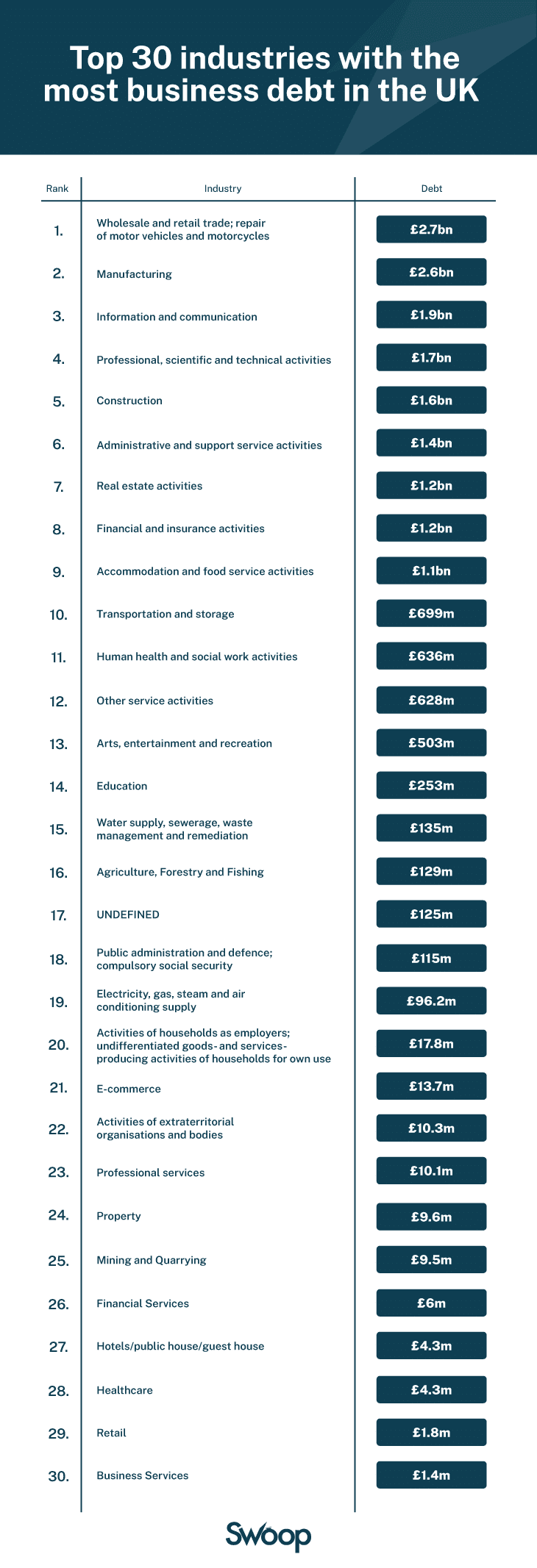
As you might expect, certain industries in the UK carry more debt than others. Wholesale and retail trade is way ahead with combined debt of more than £2.7 billionwhile manufacturing trade lagged by £2.6 billion, reflecting the capital-intensive nature of the industry.
There is also an interesting pattern that can be seen between debt size and company age. Are established companies taking on more debt than new businesses, or are startups having trouble raising cash?
Our research reveals a complex situation. For example, the business in its first five years had debts of more than £2.5 billion, however By far the largest debt is held by companies that are 21-25 years oldwith more than £1.5 billion.
Lowest debt? The business is 46 to 50 years old.
Again, there are wide regional differences between these. Unsurprisingly, startup hub London tops the list, with young companies carrying £761m of debt, while Tunbridge Wells is the location with the largest amount of legacy business debt – around £45m.
This comparison further highlights that, although established businesses carry large amounts of debt, new companies have the potential to accumulate larger amounts of debt at a faster rate.
Is gender a factor in business debt?
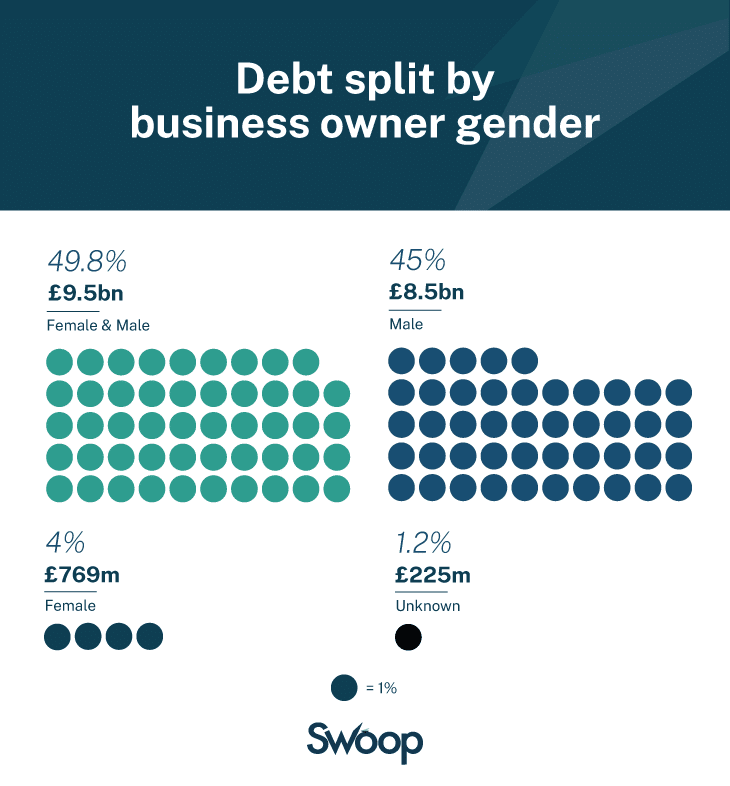
When examining the leadership of this business, we found just that 45% of the companies surveyed are owned by men, compared to just 4% owned by womenwhile 49.8% have both male and female leaders.
Although the average debt for women-led businesses is £91,755, and the debt figure for men-run businesses is £315,246, it is co-owned businesses that have the most debt at an average of £698,502 – more than double that of men-led businesses!
Tips for better navigating business debt
Understanding the nuances of business debt is vital in the current economic climate, and our research sheds light on the financial landscape in which UK businesses operate. Therefore, it is important for businesses to realize that guidance and support is available to help manage and overcome challenging financial situations:
- Assess your financial position: Review your financial statements regularly to understand your debt levels and overall financial health.
- Prioritize resolving high-interest debt: Focus on paying off debts with the highest interest rates first to reduce the overall financial burden.
- Explore refinancing options: Consider refinancing an existing loan to get a better interest rate or more favorable terms. Our guide on how to refinance a business loan offers detailed insights.
- Seek professional advice: Interact with funding experts to find customized solutions for your business. Our guide to small business loans provides valuable information.
- Develop a payment plan: Create a structured plan to manage repayments, ensuring they align with your cash flow and business operational needs.
Managing business debt can be daunting, but with a mature strategy and the right support, managing and even leveraging debt to drive growth is possible. At Swoop, we are committed to empowering businesses to make better and informed financial decisions. Subscribe to the newsletter and join 95,000+ businesses who stay informed.
Our methodology
52,143 businesses analyzed from our database.
Average debt by city and business
We analyzed the number of businesses in each city and the total debt in that city to determine the average business debt. This approach ensures fair comparisons, preventing cities with more businesses from appearing to have much higher levels of debt.
Industrial debt
This data reflects total debt across industries for all businesses using Swoop Funding.
Industrial debt by city
We collect this data into tables for easy filtering. By sorting from high to low, you can identify the top industries with the highest debt in specific cities. For example, “These are the five most indebted industries in London.”
We also have data on the industry and how much debt the company had between the years it was founded.
Debt by gender
This data examines total debt by gender, taking into account the number of men- and women-owned businesses among Swoop Funding clients. Because we had more male-led businesses in the data set, we calculated adjusted averages to ensure fair and balanced comparisons.
City data
This data set includes:
- Average business debt per city
- Debt levels are adjusted to the number of businesses
- Debt trends over time
- Business age
Article source*
expand
Swoop requires writers to use primary sources to support their work. This includes white papers, government data, original reports, and interviews with industry experts. We also reference original research from other leading publishers where necessary.
*Britain will have third strongest G7 growth in 2025, IMF estimates
News
Berita
News Flash
Blog
Technology
Sports
Sport
Football
Tips
Finance
Berita Terkini
Berita Terbaru
Berita Kekinian
News
Berita Terkini
Olahraga
Pasang Internet Myrepublic
Jasa Import China
Jasa Import Door to Door
Originally posted 2025-10-15 06:16:51.